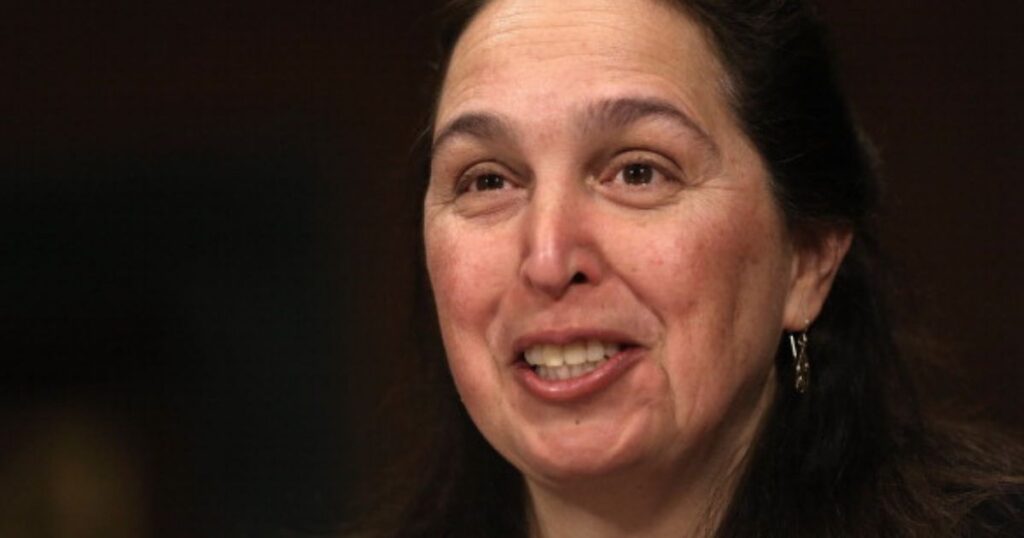
A federal judge appointed by former President Barack Obama has issued a new ruling preventing the U.S. Postal Service (USPS) from implementing President Donald Trump’s restrictions on mail-in ballots. The decision comes shortly after the U.S. Supreme Court allowed some of the Trump administration’s limits to remain in place, but Judge Indira Talwani found that the Postal Service exceeded its legal authority.
Background of the Executive Order and Legal Challenge
On March 31, President Trump signed an executive order titled “Ensuring Citizenship Verification and Integrity in Federal Elections.” This order imposed specific requirements on the USPS related to mail-in and absentee ballots. Among these was Section 3, which mandated that all outgoing election mail must be designated as “Official Election Mail,” include a unique Intelligent Mail barcode, and receive prior USPS approval for design and barcode placement.
The order stipulated that if state or local election officials failed to obtain USPS approval for envelope designs, upload voter information, or include the required barcodes, the USPS would not mail ballots to voters. This provision raised significant concerns among voting rights advocates and several states.
Judge Talwani’s Ruling and Legal Reasoning
Judge Talwani initially blocked Section 3 of the executive order in August 2026 following a lawsuit filed by the League of Women Voters of Massachusetts and other activist groups. The plaintiffs argued that the USPS lacked the authority to impose such regulations on election mail and that the rules would hinder citizens’ ability to vote by mail.
After the Supreme Court partially lifted the injunction, allowing the Trump administration to proceed with some aspects of the order, Talwani issued a new ruling on Thursday. She reversed her earlier decision to lift the injunction, once again preventing the USPS from enforcing the mail-in ballot restrictions.
In her ruling, Talwani emphasized that Congress did not delegate authority to the USPS to regulate election mail. She also found that imposing these requirements on states was unconstitutional, as it could effectively block voters from receiving ballots if the USPS did not approve them in a timely manner.
The judge imposed a fourteen-day stay on the implementation or enforcement of these rules, ensuring that the USPS cannot apply the restrictions in the lead-up to the 2026 midterm elections.
Legal Findings Highlighted by the Court
- The USPS lacked the authority to issue the final rule governing election mail.
- The final rule is unconstitutional because it imposes requirements on states beyond the agency’s mandate.
- The rule unlawfully prohibits state and local officials who do not comply with the USPS’s conditions from using the Postal Service to mail ballots.
Related Legal Proceedings and Supreme Court Involvement
Similar injunctions against the Trump administration’s mail-in ballot rules were issued by a court in California. These cases culminated in the Supreme Court case Trump v. California. The high court stayed the injunctions, allowing the administration to enforce parts of the executive order temporarily.
Despite the Supreme Court’s intervention, Judge Talwani’s ruling underscores ongoing judicial resistance to the Trump administration’s efforts to regulate election mail through the Postal Service.
Implications for the 2026 Midterm Elections
By blocking the USPS from enforcing these mail-in ballot restrictions, the ruling seeks to protect voters’ ability to participate in elections via mail without additional federal hurdles. The fourteen-day stay prevents the Postal Service from implementing the rules just before the midterms, potentially averting disruptions in ballot delivery.
The case highlights the continuing legal battles over election administration and the role of federal agencies in regulating voting procedures. As the 2026 midterms approach, courts will likely remain a critical arena for disputes over election laws and voter access.
Conclusion
Judge Indira Talwani’s latest ruling represents a significant judicial check on the Trump administration’s attempt to impose strict controls on mail-in voting through the Postal Service. By reaffirming that the USPS lacks the authority to enforce these rules and emphasizing constitutional concerns, the decision protects states and voters from potentially restrictive federal mandates ahead of the upcoming midterm elections.
Source: Read the original reporting.